The Pear Cut: A Quiet History of the Most Romantic Diamond Shape
From 15th-century Bruges to the wrists of today — why the teardrop has outlived every other shape, and why it sits so beautifully on a bangle.
4/29/20262 min read
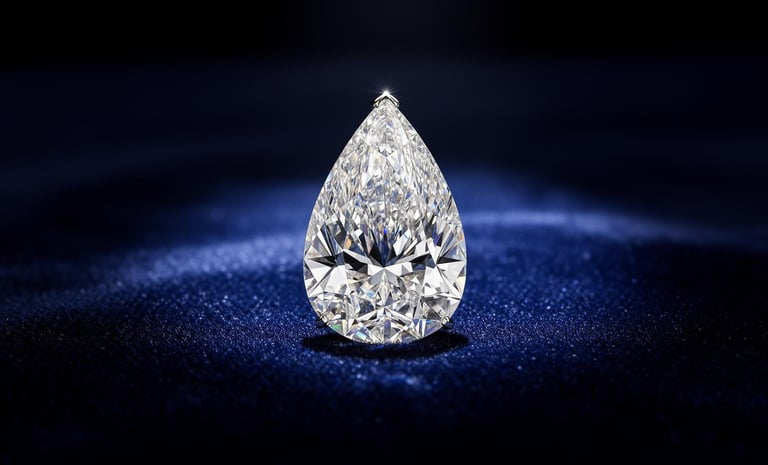
The pear cut — sometimes called the teardrop — is the oldest fancy shape still in continuous wear. Its silhouette is half brilliant, half marquise, joined at a perfect point. It catches light the way a held breath catches a thought: quietly, completely, and only for those paying attention.
Origins in 15th-century Bruges
The cut is credited to Lodewyk van Bercken, a Flemish polisher who refined the scaif — a polishing wheel charged with diamond dust and olive oil — around 1475. With it, he was the first to set facets in absolute symmetry, and the pear was among his earliest experiments. For the next four centuries, only royal commissions wore them.
Why the pear cut endures
There are reasons of geometry and reasons of feeling. Geometrically, a well-cut pear holds 58 facets — the same as a round brilliant — but distributes them across an asymmetric outline. The result is more visible fire across a larger surface area, which is why pear-cut stones often look larger than rounds of the same carat weight.
Sentimentally, the teardrop carries its own quiet narrative. It can be worn pointing up — toward the heart, traditionally a gesture of devotion — or pointing down, toward action and intention. On a bangle, the drops sit naturally along the wrist's curve, gathering and releasing light with each small movement of the hand.
Pear cuts on a bangle, specifically
Most pear-cut diamonds are set into rings or pendants, where they sit static. A bangle is different. Worn at the wrist, a row of pear drops moves with you — across a meeting room table, lifting a glass, brushing back hair. The cut was almost designed for it.
Length-to-width ratio between 1.45 and 1.75 sits most flatteringly across the bangle's curve.
A V-prong setting at the point protects the most fragile part of the stone.
Bezel settings keep the line uninterrupted — quieter, but no less beautiful.
“A pear is a brilliant that decided to lean into the light.”
— The House
Choosing your pear
If you're considering a pear-drop bangle from our atelier, the questions we'll ask first are about how you live in jewellery — daily, or for evenings; alone on the wrist, or stacked. The cut answers all of them, but the metal and the setting decide which version of the pear you'll wear.
Frequently Asked
Questions, answered.
Are pear-cut diamonds more expensive than round brilliants?
Pear cuts are typically 10–25% less per carat than round brilliants, because they retain more of the original rough stone. You usually get a larger-looking diamond for the same budget.
Which way should the pear point?
There is no rule. Toward the heart is traditional for rings; on a bangle, the drops are usually arranged in a continuous symmetrical row.
Is a pear-cut diamond fragile?
The point is the most vulnerable area. We always set with a V-prong or bezel at the tip to protect it for everyday wear.
Discover the Pear Drop Collection.
Address
Contacts
Subscribe to our newsletter
Atelier
London, United Kingdom
By Email